Chinoiserie (say it: shin-WAH-zer-ee) is the centuries-old European design tradition of depicting lush Asian-inspired landscapes — think oversized peonies, trailing branches, exotic birds, and misty mountains — on walls, furniture, and fabric. As a wallpaper style, it lands somewhere between a botanical illustration and a painted mural: maximalist, layered, and distinctly dramatic. If you’ve ever scrolled past a jaw-dropping dining room or powder bath on a design site and thought what is that wallpaper? — odds are good it was chinoiserie. The problem is that the real hand-painted version, the kind made panel by panel by an artist with actual pigment, routinely runs $800 to $1,400 per panel. For an average dining room you might need eight to twelve panels. The math hurts. This guide is for the reader who loves the look, has a real room to wallpaper, and wants to know exactly where the honest middle-ground lives between a $90 inkjet roll and a $10,000 custom commission.
What You’re Actually Paying For (and What You’re Not)
Before we talk brands, it’s worth naming the spectrum clearly, because the category language has gotten genuinely messy. Architectural Digest’s complete guide to wallpaper styles distinguishes three tiers: hand-painted (artist applies pigment directly to substrate, each panel is a one-of-a-kind original), hand-printed (a block, screen, or roller applies ink by hand in repeated passes — reproducible, but tactile), and digitally printed (inkjet or laser reproduction of an original artwork, often sold as “art-inspired” or “mural-style”). The premium price — the $1,200-a-panel number — belongs almost entirely to the first category: studios like de Gournay and Gracie, where trained artists spend weeks on each set.
The mid-tier picks in this article are almost all digitally printed from original artwork. That’s not a slur — it’s accurate. A great digital print on a quality substrate, with the right texture and finish, can look extraordinary in person and last decades with proper installation. The question is whether the brand is honest about what it is, whether the original artwork it’s printing from is genuinely beautiful, and whether the substrate and ink quality justify the price. That’s the evaluation frame we’re working from here.
A quick note on what the mid-tier actually costs in 2026:
- Budget end: $50–$100 per roll (standard 20.5” × 33’ rolls), typically inkjet on thin paper
- Mid-tier: $120–$280 per roll, or $180–$450 per panel in mural formats
- Bespoke/true hand-painted: $600–$1,400+ per panel, custom sizing
For a 12-foot accent wall, you’re typically looking at 3–4 double rolls at mid-tier pricing. That puts a real chinoiserie-look wall in the $500–$1,100 range before paste, primer, and installation — a genuinely different number than the DIY buyer who budgeted $400 total. The Spruce’s step-by-step installation guide notes that first-time DIY hangers should also budget $40–$80 for proper wallpaper primer (size coat) and $25–$60 for paste or activator, depending on whether the paper is pre-pasted.
The Mid-Tier Brands Worth Actually Sampling
Here’s where we get direct. Several brands occupy the $150–$350-per-roll space with chinoiserie or botanical mural designs. Not all of them earn it.
Rifle Paper Co. consistently surfaces in reader conversations on Apartment Therapy as a gateway chinoiserie option — it’s not traditional chinoiserie, technically, but their botanical mural prints hit the same visual register (illustrated florals, layered garden scenes) at a price point that makes a full room possible. Their papers are digitally printed from original gouache illustrations, which they’re transparent about. Reviewers across aggregated design community reviews note that the colors read true to the swatch, which is rarer than it should be at this price.
Timorous Beasties occupies a harder-to-categorize space. Per Elle Decor’s overview of best wallpaper brands, they’re a Glasgow-based design house whose botanical prints carry genuine artistic credentials — the original artwork is distinctive and not easily mistaken for stock illustration. Reviewers note the paper weight is substantial and the ink depth holds in rooms with variable light. The pricing sits at the upper edge of mid-tier, but the design differentiation is real.
Tempaper is the brand most worth naming explicitly for renters. Their peel-and-stick chinoiserie-adjacent botanical panels have accumulated a meaningful track record in Apartment Therapy’s renter-safe roundups, and unlike the generation of peel-and-stick papers from five years ago, recent owner reports suggest the adhesive has improved enough that edge-lifting in the first year is no longer the default complaint. For a rental where you want statement-wall energy without security-deposit anxiety, it’s the honest recommendation. The aesthetic ceiling is lower than paste-up papers — the surface doesn’t have the same dimensional quality — but it’s real.
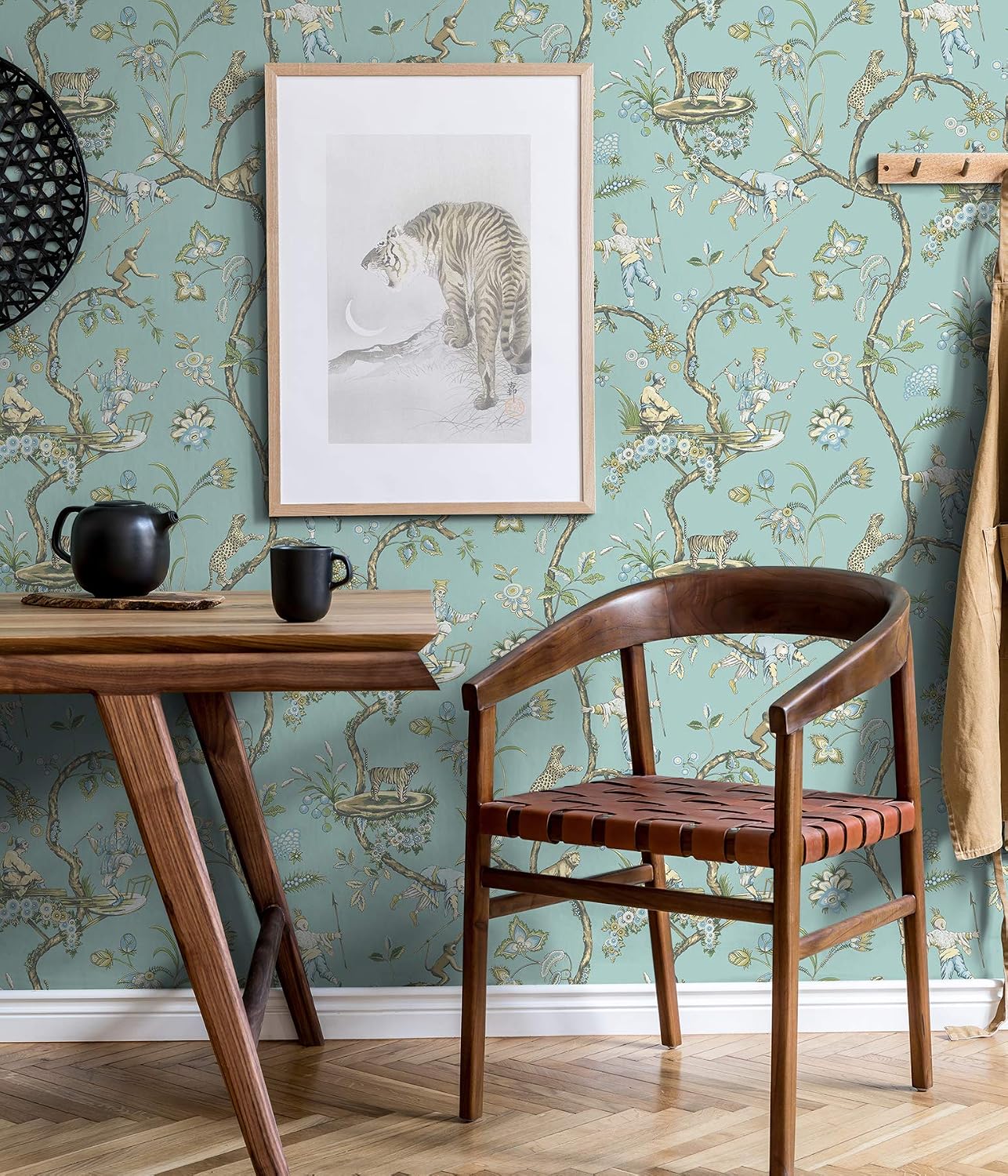
NuWallpaper
$51.50
In stock on Amazon
Check price on AmazonSerena & Lily and Hygge & West both offer chinoiserie-influenced designs in the $85–$175 per roll range. They’re honest about being digitally printed. Better Homes & Gardens’ overview of wallpaper murals mentions both in the context of accessible botanical mural options. The tradeoff: at the lower end of that range, the substrate is thinner and the ink less saturated than the mid-tier ceiling. Order samples before committing — the difference between their entry price and their premium-line papers is visible in person even if it’s hard to judge from website photography.
NuWallpaper
$51.50
In stock on Amazon
Check price on AmazonFor buyers who want to step closer to the hand-crafted aesthetic without the full bespoke price, Elitis (a French house) and Brewster Wallcovering’s Advantage line both print on textured substrates that add dimensionality to the pattern. Elitis in particular sources from original painted artwork and uses embossing on several chinoiserie lines. Per Elle Decor’s brand overview, their papers are distributed through to-the-trade showrooms but increasingly available direct. They’re at the top of mid-tier pricing — $250–$400 per roll — but owner reports from interior designers in professional forums consistently describe them as the most convincing digital-print approximation of the hand-painted look available below the de Gournay floor.
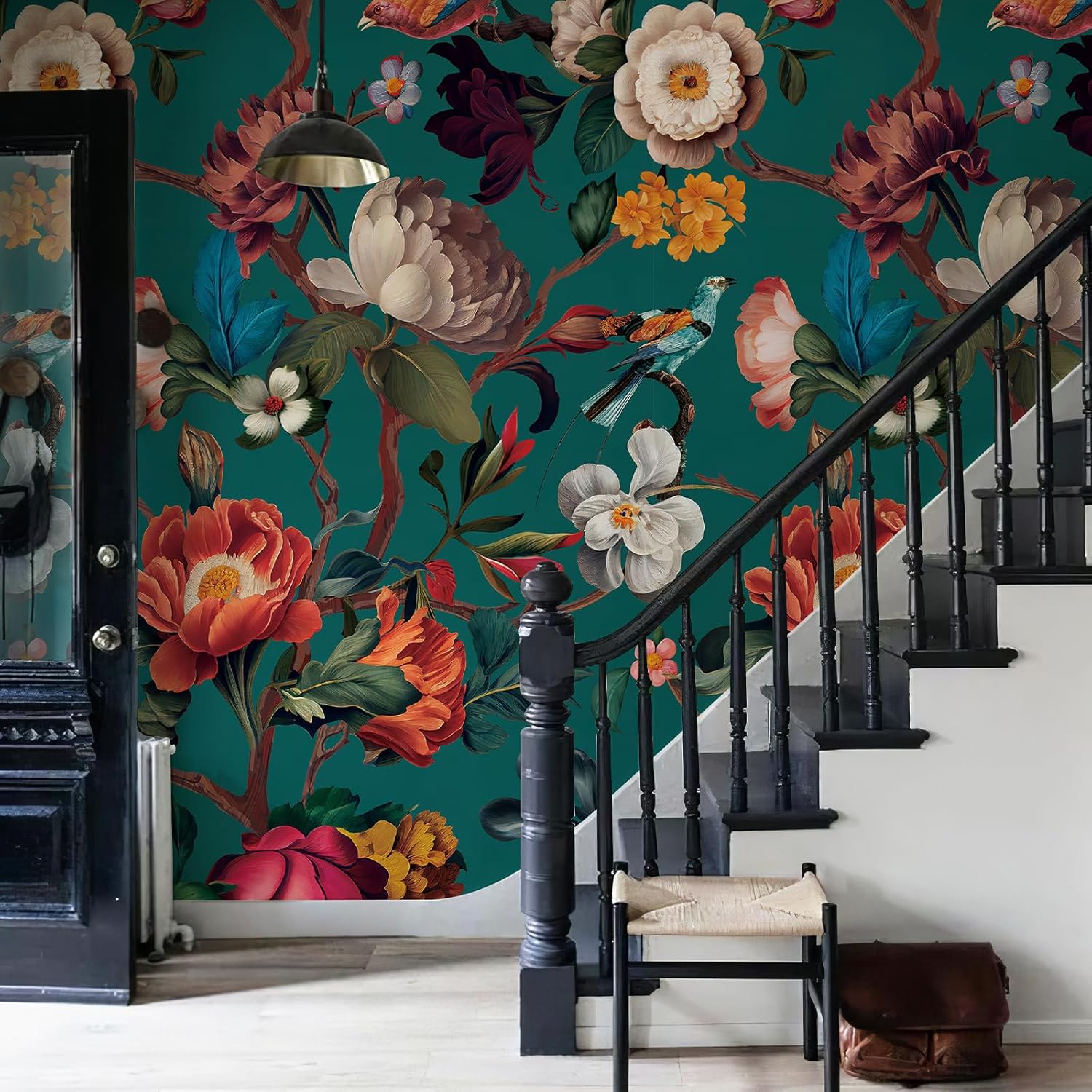
Zeeko
$179.99
In stock on Amazon
Check price on AmazonThe Sample Mandate (and How to Actually Read One)
If there’s one habit this site returns to repeatedly, it’s this: order the sample before you commit. For chinoiserie and botanical murals especially, the gap between screen representation and physical reality is enormous in both directions — sometimes better, sometimes worse.
When your samples arrive, evaluate them under the actual lighting conditions of the room you’re papering. Chinoiserie designs with a lot of metallic ink (gold leaf effects, silver branch tracery) behave completely differently under warm incandescent light versus cool north-facing daylight. Better Homes & Gardens specifically calls out this lighting variable in their mural wallpaper guide as the most common source of buyer disappointment in the category.
Check the repeat. A “drop match” repeat (where the pattern shifts up or down between strips) adds waste — typically 15–25% more material than a straight match. On a design with a 36-inch drop match (common in large-scale chinoiserie), a 12-foot ceiling room can require significantly more rolls than the basic square-footage calculation suggests. The Spruce’s installation guide recommends calculating for at least 20% overage on drop-match patterns for first-time hangers.
Ask the brand one direct question before ordering a full room: “Is this paper designed to be trimmed at the seam, or is it pre-trimmed?” Untrimmed (or “selvage”) paper requires a professional installer or significant experience. Several mid-tier brands sell untrimmed because it’s how the paper comes off the press; they don’t always flag it clearly.
NuWallpaper
$51.50
In stock on Amazon
Check price on AmazonBy the Numbers
| Tier | Typical price per roll / panel | What you get | Full accent wall estimate (12×9 ft) |
|---|---|---|---|
| Budget ($50–$100/roll) | Inkjet on thin paper, flat finish | Accessible look, limited depth | $200–$400 + supplies |
| Mid-tier ($150–$280/roll) | Digital print on quality substrate, some texture options | Honest design quality, good longevity | $600–$1,100 + supplies |
| Premium mid ($300–$450/panel) | Textured substrate, embossed or metallic finish, original artwork | Closest to hand-painted without custom pricing | $1,200–$1,800 + install |
| True hand-painted ($800–$1,400+/panel) | Artist-applied pigment, one-of-a-kind | The real thing | $6,400–$16,800+ |
The Decision Rule
The mid-tier chinoiserie category is genuinely good right now. The artwork quality coming out of independent design houses has improved, substrate and ink technology has closed a meaningful portion of the gap with hand-painted, and the pricing has stabilized after the supply disruptions of the early 2020s. But it still requires honest decision-making.
If you’re renting: Tempaper or a peel-and-stick botanical from a brand with documented reapplication success is the right call. Don’t let a gorgeous paste-up mural design tempt you into risking your deposit. The aesthetic ceiling is real, but so is the deposit.
If you own the space and your budget ceiling is around $800–$1,000 for the wall: The honest mid-tier from Rifle Paper Co., Hygge & West premium line, or Brewster’s textured options gets you a genuinely beautiful room. Order three to four samples, evaluate them in your lighting, and commit to the one that reads truest in person.
If you can push to $1,200–$1,800 for the wall and want it to look expensive: Elitis or Timorous Beasties at the premium-mid level is where the investment pays off most clearly. These are papers that trained eyes notice. They’re also the ones most likely to still look right in ten years when design trends shift, because the artwork underneath is strong enough to outlast cycles.
If a brand won’t send you a sample, or if their sample is a 2-inch swatch of a 12-foot pattern: that’s information. A brand confident in their product sends you enough to evaluate color, texture, and scale in context. The ones that don’t are usually protecting against comparisons they’d lose.
Zeeko
$179.99
In stock on Amazon
Check price on AmazonNuWallpaper
$51.50
In stock on Amazon
Check price on AmazonThe $1,200-a-panel benchmark is real, and for what de Gournay and Gracie actually make, it’s arguably fair — those panels are genuine artwork on your walls. But it was never the only path to a room that stops people at the doorway. The mid-tier has earned its place. Order the samples.