Forest mural wallpaper — that’s a single large-format image of trees, branches, or woodland scenes printed or painted across a wall, usually spanning the full height and width of one room surface — has been one of the most-searched bedroom upgrades for the past three years. If you’ve landed here after typing something like “forest wallpaper bedroom” into Google at midnight, welcome. The short version: this category is genuinely beautiful, genuinely easy to get wrong, and genuinely fixable once you understand two variables — scale (how large the motifs are relative to your room) and palette (the color family the design lives in). Get those right, and a forest mural bedroom feels like sleeping inside a painting. Get them wrong, and it feels like the trees are leaning over you. This guide will walk you through both, show you the math, and give you a clear decision framework before you place a single order.
Why Scale Is the Variable Most Buyers Underestimate
Scale refers to the size of the design’s motifs — the individual tree trunks, leaf clusters, or branch spreads — relative to your ceiling height and wall width. It’s the single most common source of buyer’s remorse in the mural category, as noted in Apartment Therapy’s coverage of mural wall mistakes.
Here’s the practical problem: wallpaper is sold as a flat image. You look at a thumbnail on a brand’s website and it looks airy and proportionate. What you’re actually seeing is a compressed version of a design that, when installed, may place tree trunks that are 14 inches wide on a wall that is only 10 feet across. The effect isn’t immersive — it’s claustrophobic.
The ceiling-height rule of thumb designers use:
| Ceiling Height | Max Recommended Motif Scale | Practical Example |
|---|---|---|
| 8 ft | Fine-to-medium (motifs under 18” tall) | Birch stand, delicate branch pattern |
| 9–10 ft | Medium-to-large (motifs 18”–36” tall) | Full tree trunks, mid-canopy scenes |
| 11 ft+ | Large or panoramic (motifs 36”+) | Full-forest floor-to-canopy panoramas |
The Spruce’s wallpaper ordering guide emphasizes that mural panels — wallpaper sold in coordinated panels that together form one continuous image, rather than a repeating tile — should always be previewed at their installed dimensions, not their thumbnail. Most reputable brands publish the actual installed width and height per panel set. If a brand doesn’t list those numbers, that’s a red flag.
What to do in a standard 8-foot bedroom: Look for designs described as “atmospheric” or “tonal” rather than “dramatic” or “panoramic.” These tend to feature softer tree silhouettes, mist effects, or canopy views from below — motifs that read as environment rather than obstacle. Fine-scale birch forests and watercolor woodland scenes consistently perform better in lower-ceiling rooms than the full-drama dark-forest murals that photograph beautifully in design magazines (which almost exclusively show rooms with 11-foot ceilings).
 product image](/images/external/a610bf71c93c.jpg)
AMUGISH
$62.85
In stock on Amazon
Check price on AmazonReading Palette Honestly: The Calm vs. Crowd Problem
Palette in forest murals works differently than palette in solid or geometric wallpaper. You’re not just choosing a color — you’re choosing a light quality, a time of day, and a psychological register.
Forest murals generally fall into four palette families:
1. Pale & Misty (whites, pale greens, soft grays) These lean toward watercolor or wash aesthetics. They add texture and depth without advancing toward the viewer. Architectural Digest’s wallpaper guides consistently note that pale-palette murals in bedrooms read as “expanding” the space rather than filling it. Best for small rooms, renters who want impact without commitment, and anyone whose primary bedroom goal is calm.
AMUGISH
$62.85
In stock on Amazon
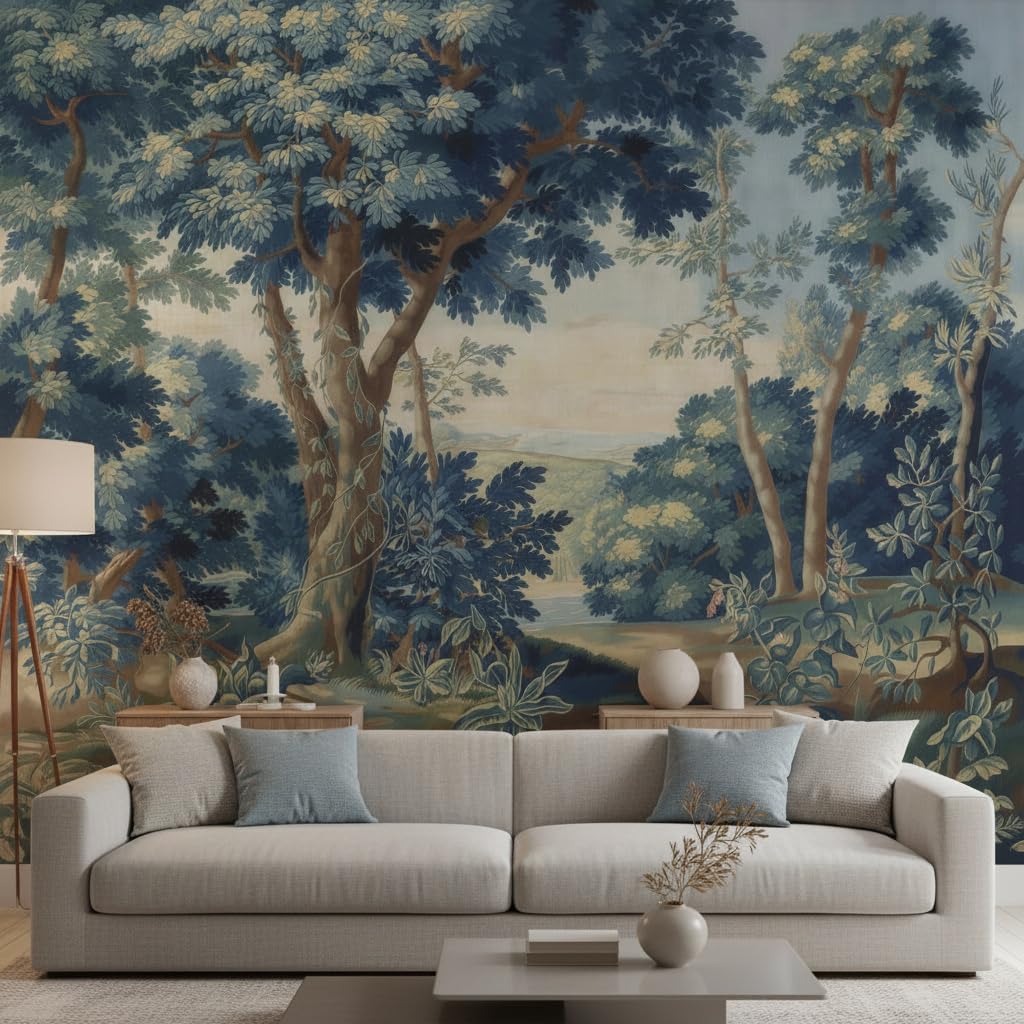
Check price on Amazon2. Deep & Moody (navies, forest greens, charcoals, blacks) These are the designs that dominate design inspiration boards — and the ones that most frequently disappoint in real rooms. The issue isn’t the dark palette itself; it’s that dark motifs on dark grounds compress space, and in a bedroom that already has a bed, nightstands, and lamps competing for visual real estate, a heavily saturated mural can make the room feel smaller at night than it does in daylight. Better Homes & Gardens wallpaper coverage notes that dark murals work best as a single accent wall behind the bed — never on three or four sides.
If you’re committed to deep-palette forest murals (and there are genuinely gorgeous ones), apply a simple test: will this wall be partially blocked by your headboard? If a significant portion of the mural’s drama is going to disappear behind furniture, you’ve paid for something nobody can see. Use the deep palette where it shows.
 product image](/images/external/b2a3d35f8a54.jpg)
Reyhui
$129.99
In stock on Amazon
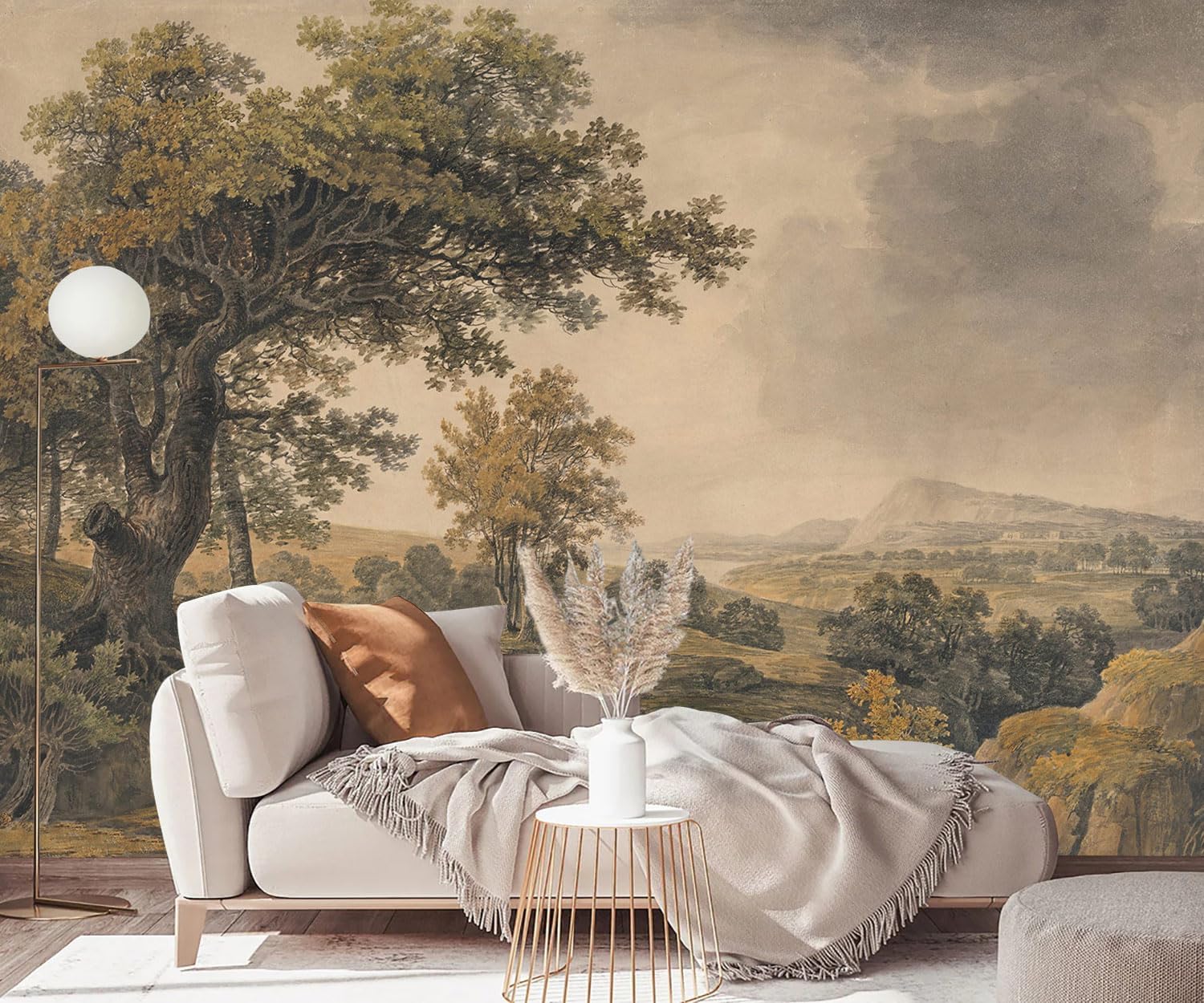
Check price on Amazon3. Warm Naturals (ochres, taupes, terracottas, amber) The fastest-growing segment in nature murals right now, per Apartment Therapy’s 2025 trend reporting. Warm naturals hit the sweet spot between the “too precious” quality of pale misty forests and the high-commitment drama of deep moody ones. They pair with wood furniture naturally and age well — they don’t date the way a very-trend-specific green does.
YQWDMX
$169.90
In stock on Amazon
Check price on Amazon4. Illustrated & High-Contrast (black line on white, botanical print style) These borrow from scientific illustration and block-print traditions. They’re technically forest wallpaper but read as art rather than environment. They’re the easiest to live with long-term because they function as pattern, not mood. Best for buyers who aren’t sure they can commit to a fully immersive mural aesthetic.
Blue
$149.99
In stock on Amazon
Check price on AmazonThe True Cost of a Forest Mural Project (The Number Nobody Shows You Up Front)
This is where a lot of mid-range buyers get surprised. You budget $120 per roll, order five rolls, and think you’re in for $600. But the full-project math looks like this:
By the numbers — typical 12×10 ft bedroom accent wall, 2026 pricing:
- Wallpaper (mural panels, mid-tier): $280–$480
- Primer (wallpaper-specific, not standard paint primer): $35–$55
- Paste or pre-paste activator: $20–$40
- Seam roller, smoothing brush, snap-line tools: $25–$45 (one-time)
- Professional installation (if not DIY): $200–$450 for one wall
Total DIY: $360–$620. Total installed: $560–$1,070.
The Spruce’s wallpaper ordering guide makes the point that buyers should treat primer as non-negotiable, not optional. Raw drywall absorbs paste unevenly, which causes lifting at seams and bubbles under panels. A $40 bottle of wallpaper-specific primer (not the flat latex paint primer you have left over from last fall) is the most cost-effective insurance in the entire project.
If you’re in the premium tier and looking at bespoke or artist-panel sets above $300 per panel, professional installation isn’t just recommended — it’s essentially required. A misaligned seam on a $900 panoramic mural is an expensive and demoralizing outcome.
Reyhui
$129.99
In stock on Amazon
Check price on AmazonMural vs. Repeating Pattern: The Decision Most Buyers Delay Too Long
A mural is a single continuous image printed across multiple panels — you see the full forest scene only when all panels are installed together. A repeating pattern is a motif (tree, leaf, branch) that tiles across the wall, so any section of wall reads as complete on its own.
This distinction matters more in a bedroom than in any other room because:
-
Furniture placement is permanent. If you hang a mural and later move your dresser to the right side of the wall, you may expose a section of mural that was designed to be behind furniture. Repeating patterns are furniture-agnostic.
-
Ordering extras is different. With a mural, over-ordering means you have extra panels you can’t use elsewhere. With a repeating pattern, extra rolls can be used for repair patches or in closets.
-
Renters have real limitations. Peel-and-stick mural panels — wallpaper backed with repositionable adhesive rather than paste, specifically designed to be removed without damaging walls — have gotten dramatically better in the past two years. Reviewers across home-improvement communities consistently note that the highest-quality peel-and-stick options now hold cleanly through two or three seasonal removals without edge lift, particularly on smooth, well-primed drywall. If you’re renting, this is no longer a compromise category.
Reyhui
$129.99
In stock on Amazon
Check price on AmazonSample-First Is Not Optional at This Price Point
If there is one habit that separates buyers who love their final room from buyers who post regret threads, it is this: order physical samples before committing to full panels.
The reason is specific to forest murals. Digital renderings of murals on brand websites are almost universally shown in idealized lighting — usually bright, directional natural light at mid-morning. Your bedroom has a different light signature: lamp-warm evenings, low-angle morning sun, possibly north-facing windows with cool diffuse light all day. A pale misty forest that looks ethereal at 10am in a well-lit studio can read flat and dull in a north-facing bedroom in November. A moody dark forest that photographs as dramatic can genuinely feel oppressive in a room that already has minimal natural light.
Most mid-range brands charge $5–$15 per sample swatch and apply that cost to your final order. Premium brands often provide larger memo samples (that’s trade language for a sample sized large enough to show a full motif repeat) on request. The Spruce explicitly recommends taping samples to the target wall for at least 48 hours, observing at different times of day, before ordering full panels. That’s not caution — that’s the actual minimum due diligence at $300+ spend.
Reyhui
$129.99
In stock on Amazon
Check price on AmazonThe Decision Framework: If X, Then Y
You’ve done the research. Here’s where it lands:
If your room has 8-foot ceilings and is under 150 square feet: Choose a pale or warm-natural palette with fine-scale motifs, or an illustrated repeating pattern. Avoid full-floor-to-ceiling trunk murals. Prioritize peel-and-stick format if renting.
If your room has 9-foot+ ceilings and you want drama: A deep-palette mural behind the bed works — but install it on one wall only, and make sure at least 40% of the mural surface is visible above your headboard. Order a physical sample and live with it for a week.
If you’re committed to a DIY install: Stay in the peel-and-stick or paste-the-wall format (where paste goes on the wall, not the paper — easier to manage solo). Avoid paste-the-paper formats on your first mural project. One person hanging a paste-the-paper mural alone in an 8-foot hallway is a manageable project; one person hanging paste-the-paper panels in a bedroom at 11pm is a disaster scenario.
If your budget is under $150 total: A repeating illustrated forest pattern in a mid-format repeat will serve you better than a low-resolution mural stretched to fill your wall. Resolution matters at life-size, and budget murals often sacrifice it. Architectural Digest’s wallpaper buying guides note that printed resolution is one of the most common quality gaps between budget and mid-tier digital wallpaper.
If your budget is $300+ per panel set: You are now in bespoke and artist-panel territory. Request memo samples, confirm printed dimensions in writing before ordering, and budget professional installation into the project total from the start. At this price point, installation cost is not the place to save money.
YQWDMX
$169.90
In stock on Amazon
Check price on AmazonThe forest is a forgiving motif when you let it breathe. Give it the right wall, the right scale, and the right light — and it will be the reason people ask what you did to the room every time they walk in.