Real grasscloth wallpaper — that’s the woven natural fiber covering (think dried seagrass, jute, or sisal laminated onto a paper backing) that you’ve probably seen in coastal living rooms and boutique hotel lobbies — costs anywhere from $8 to $30 per square foot installed, and it cannot get wet, scuffs if you look at it sideways, and is essentially non-negotiable to remove without damaging the drywall underneath. So when peel-and-stick wallpaper (a self-adhesive, removable vinyl or fabric-backed sheet that you press directly onto a painted wall) started mimicking that woven look, the design world took notice. The pitch is compelling: all the warmth and organic texture of grasscloth, none of the installation drama, and you can take it down when you move or change your mind.
The problem — and the reason this article exists — is that “faux grasscloth” is doing a lot of heavy lifting as a marketing phrase right now. Some of these products genuinely fool the eye at conversational distance. Others look exactly like what they are: a photograph of texture printed on flat vinyl. If you’re mid-renovation with a sample cart open and a feature wall to commit to, you need a sharper decision frame than “this one has good reviews.” Here’s how to build it.
What “Texture” Actually Means in Peel-and-Stick
This is the core distinction most product listings obscure: printed texture versus embossed texture. Printed texture is a photograph of a woven surface rendered in ink on a flat substrate. Embossed texture is a physical three-dimensional relief pressed into the material itself during manufacturing. These are not the same thing, and they do not read the same way in a room.
Printed-only texture falls apart the moment light rakes across it at an angle — morning sun from a side window, a sconce on a dimmer, the glow from a table lamp. Flat vinyl reflects light uniformly, so the woven illusion collapses. Embossed or raised-surface products catch and scatter light the way real fiber does, which is what keeps the illusion alive past the first afternoon in the room.
Architectural Digest’s buyer’s guide on grasscloth alternatives notes that “the convincing factor in any faux-fiber wallcovering is almost always the surface topography, not the print.” That’s the sentence to carry into every product listing you read. Look specifically for these terms in spec sheets:
- Embossed vinyl — a physical relief in the vinyl layer itself
- Non-woven with surface texture — a fabric-backed substrate where the weave of the backing material shows through
- 3D texture layer — a separate relief coat applied over the print
- Matte finish — not a texture term, but matte kills specular reflection and is a meaningful proxy for realism
Glossy or semi-gloss finishes are almost always a visual tell that kills the grasscloth effect. The Spruce’s overview of grasscloth alternatives makes this point explicitly: “Real grasscloth has an inherently matte, light-absorbing surface because the fibers themselves scatter rather than reflect light.”
The Texture Spectrum: Where Peel-and-Stick Products Actually Land
Across aggregated reviews and manufacturer spec sheets, faux grasscloth peel-and-stick products cluster into three performance tiers. These aren’t brand tiers — they’re realism tiers, and they map imperfectly onto price.
Tier 1 — Flat Print (Lowest Realism) Printed woven pattern on smooth vinyl or polyester. Works in low-light rooms or when viewed from across a large space. Fails under directional lighting. Typically the cheapest option and the most common thing you’ll find searching generic marketplaces. Owners in aggregated reviews consistently describe this category with phrases like “looks great in photos, less convincing in person.”
 product image](/images/external/d801dde89424.jpg)
NuWallpaper
$32.45
In stock on Amazon
Check price on AmazonIf your wall is in a hallway, a windowless powder room, or a space where the primary light source is overhead and diffuse, Tier 1 can pass. If the wall faces a window or sits near a lamp, budget for better.
Tier 2 — Embossed Vinyl or Textured Non-Woven (Mid Realism) This is where the category gets interesting. Embossed vinyl products have a genuine raised grid that catches oblique light. Non-woven products — where the paper-fabric backing itself has visible weave — add tactile depth. Apartment Therapy’s renter wallpaper guide flags non-woven backing as a meaningful durability and realism upgrade: “the texture you feel when you run a finger across it is the texture you see when light hits it at an angle.”
Reviewers across major retail platforms consistently rate this tier as the sweet spot: more convincing than flat print, installed by the same peel-and-stick method, and in the $18–$32-per-roll range as of mid-2026. The tradeoff is that embossed vinyl is slightly less forgiving on irregular or heavily-textured existing walls — the emboss can trap air bubbles more easily than smooth vinyl.
 product image](/images/external/31dbe868c895.jpg)
Haimin
$39.99
In stock on Amazon
Check price on AmazonTier 3 — Deep-Emboss or Fabric-Surface Products (Highest Realism) A smaller category of products uses a thick emboss layer or an actual woven fabric surface laminated over the adhesive backing. These are the ones that genuinely require a second look to distinguish from real grasscloth, especially in photographs. The tradeoff: they’re heavier, harder to reposition once placed, and some have limited restickability if you lift a panel. Better Homes & Gardens’ installation guide warns that “heavier textured products have a shorter repositioning window — work in shorter strip lengths and have a partner hold the panel.”
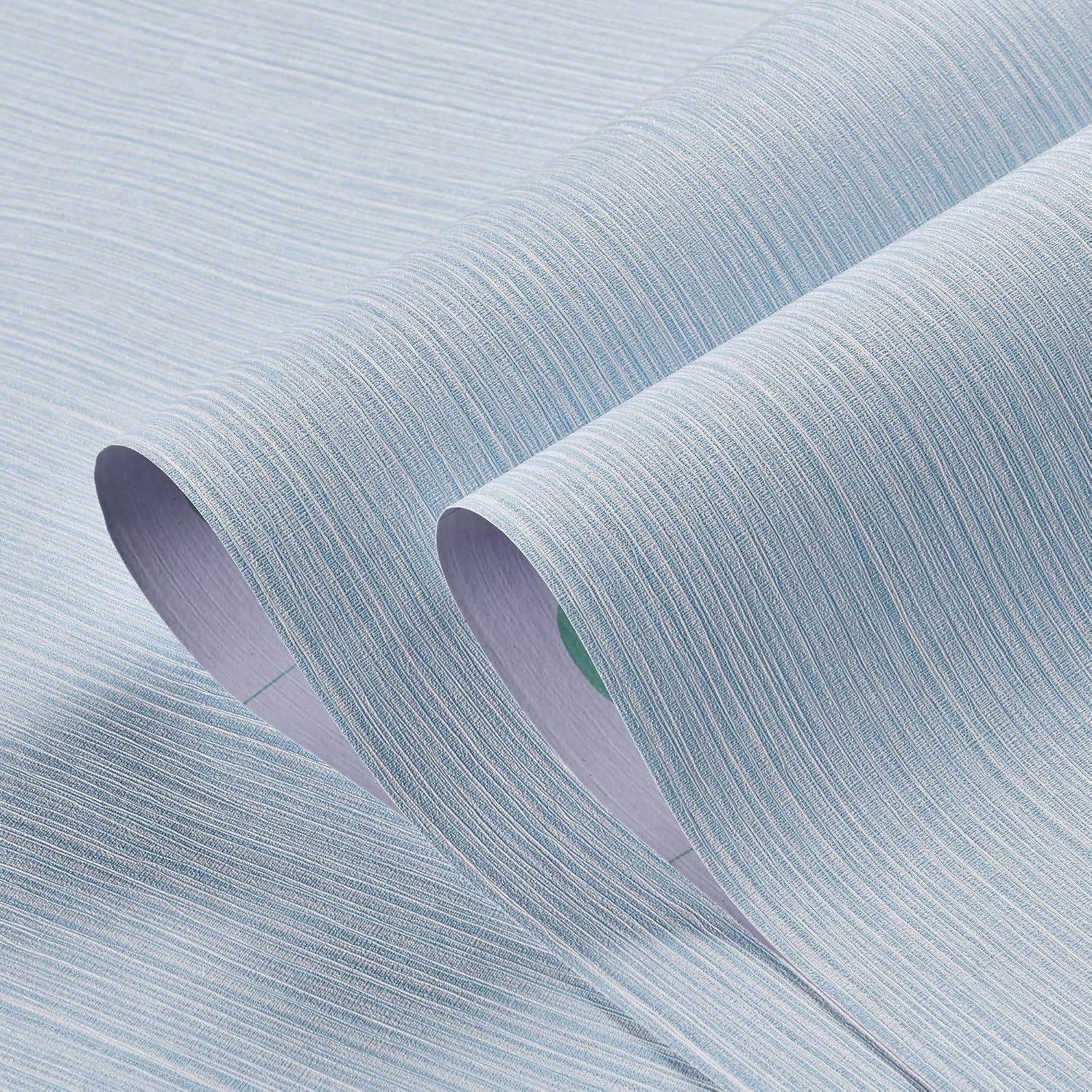
Haimin
$41.99
In stock on Amazon
Check price on AmazonBy the Numbers
| Realism Tier | Typical Price Range (per roll, 2026) | Texture Type | Fails Under |
|---|---|---|---|
| Flat Print | $8–$15 | Printed only | Directional/raking light |
| Embossed Vinyl | $18–$28 | Physical relief + print | Heavily textured existing walls |
| Fabric-Surface / Deep Emboss | $30–$43 | Woven face or thick emboss | Impatient installation |
The Variables That Actually Determine Whether It Works
Wall prep is non-negotiable — and most people skip it.
Peel-and-stick on unpainted drywall, flat paint (anything with a sheen below eggshell), or walls with even minor surface irregularities will fail. Hunker’s faux texture wallpaper buying guide puts this plainly: “Peel-and-stick adhesive bonds to surface chemistry, not just physical contact. A wall that hasn’t been primed or that has a chalky flat paint will release the adhesive within weeks.” The site recommends at minimum a satin or eggshell finish paint cured for 30 days before application.
For renters applying to walls they can’t repaint, there are workarounds — a thin layer of matte wallpaper-safe primer applied with a foam roller and allowed to cure is a common approach reported by owners in long-run reviews. The risk: in most leases, any wall modification including primer is a gray area. Read your lease before you do anything.
Panel width and pattern repeat affect how visible seams are.
Most peel-and-stick grasscloth products come in either 24-inch or 20.5-inch widths. Real grasscloth typically comes in 36-inch widths, which means fewer seams on a standard 8-foot wall. The narrower the panel, the more seams you’re managing, and seams in embossed products are harder to hide than seams in smooth wallpaper because the texture interruption is tactile, not just visual. Look for products that explicitly describe a “butt seam” pattern match — meaning the pattern is designed to align edge-to-edge without offset — and reviews that specifically mention seam visibility.
Haimin
$39.99
In stock on Amazon
Check price on AmazonColorway matters more than you think.
Real grasscloth reads differently in every light condition because natural fibers hold pigment inconsistently — that’s part of its charm. The best faux products replicate this by printing with slight tonal variation within each “strand.” Products described only as a single flat color (one hex value, no variation) are almost always flat-print Tier 1. Look for descriptions that use words like “variegated,” “natural color variation,” or “hand-dyed look” — these signal that the designer accounted for the visual complexity of real fiber.
The Spruce’s grasscloth alternatives piece notes that “warm neutrals — camel, flax, greige — are more forgiving in faux grasscloth because the eye expects tonal variation in those color families. Saturated colors like deep blue or charcoal read as flat much faster.”
NuWallpaper
$32.45
In stock on Amazon
Check price on AmazonThe Decision Framework
If you’re sitting with a decision pending, run through this logic:
If the wall gets directional light from a window or lamp within 10 feet: Flat print will disappoint you. Minimum viable option is embossed vinyl. Haimin — $39.99 Budget for it.
If you’re renting and the stakes of adhesive failure are high: Weight your decision toward non-woven backed products over pure vinyl — non-woven breathes slightly, adheres more evenly on imperfect surfaces according to aggregated owner reviews, and releases more cleanly per Apartment Therapy’s renter guide.
If the wall is longer than 12 feet or you’re papering a full room: Seam math matters. At 20.5-inch panel width, a 12-foot wall needs roughly 7 panel drops. At 24-inch width, 6. That’s a meaningful difference in seam visibility and installation time. Haimin — $41.99 products in wider panels will save you a half-day and look better at the end of it.
If you’re in the $8–$15 range because that’s the actual budget: Use flat print, but choose a room with overhead-only lighting, and go with a warm neutral colorway. A powder room with no natural light and a ceiling fixture is an honest use case for Tier 1. NuWallpaper — $32.45 Don’t fight physics elsewhere.
If you want the result to be genuinely indistinguishable from real grasscloth in a photo or on a video call: Only deep-emboss or fabric-surface products clear that bar. Plan for $30–$43 per roll, careful installation, and a partner on the day of hanging. Haimin — $41.99 The math still wins versus $8–$30 per square foot for installed real grasscloth, even at the high end.
The One Habit That Prevents Expensive Mistakes
Order samples before committing to full rolls. This is not optional advice for a product category where texture is the entire value proposition. A 12×12-inch or 8×10-inch sample taped to the actual wall in the actual light conditions of the room tells you more in one evening than any product listing or review can. Hold it under your lamp. Walk past it without looking directly at it. Check the seam against a straight edge.
Better Homes & Gardens’ installation guide makes the same point from the installer’s perspective: “The sample step also lets you test adhesion on your specific wall surface before you commit 12 rolls to it.”
Sample orders typically run $2–$8 per sheet depending on the brand, and most brands apply that cost toward a full order. It is the highest-return thirty minutes in a wallpaper project.
Haimin
$41.99
In stock on Amazon
Check price on AmazonThe faux grasscloth category has genuinely gotten better in the past two years — emboss depth is more convincing, colorways have more sophistication, and installation tolerances have improved. But “better than it was” isn’t the same as “good enough for every application.” Know your light conditions. Know your wall prep situation. Order the sample. Then commit.