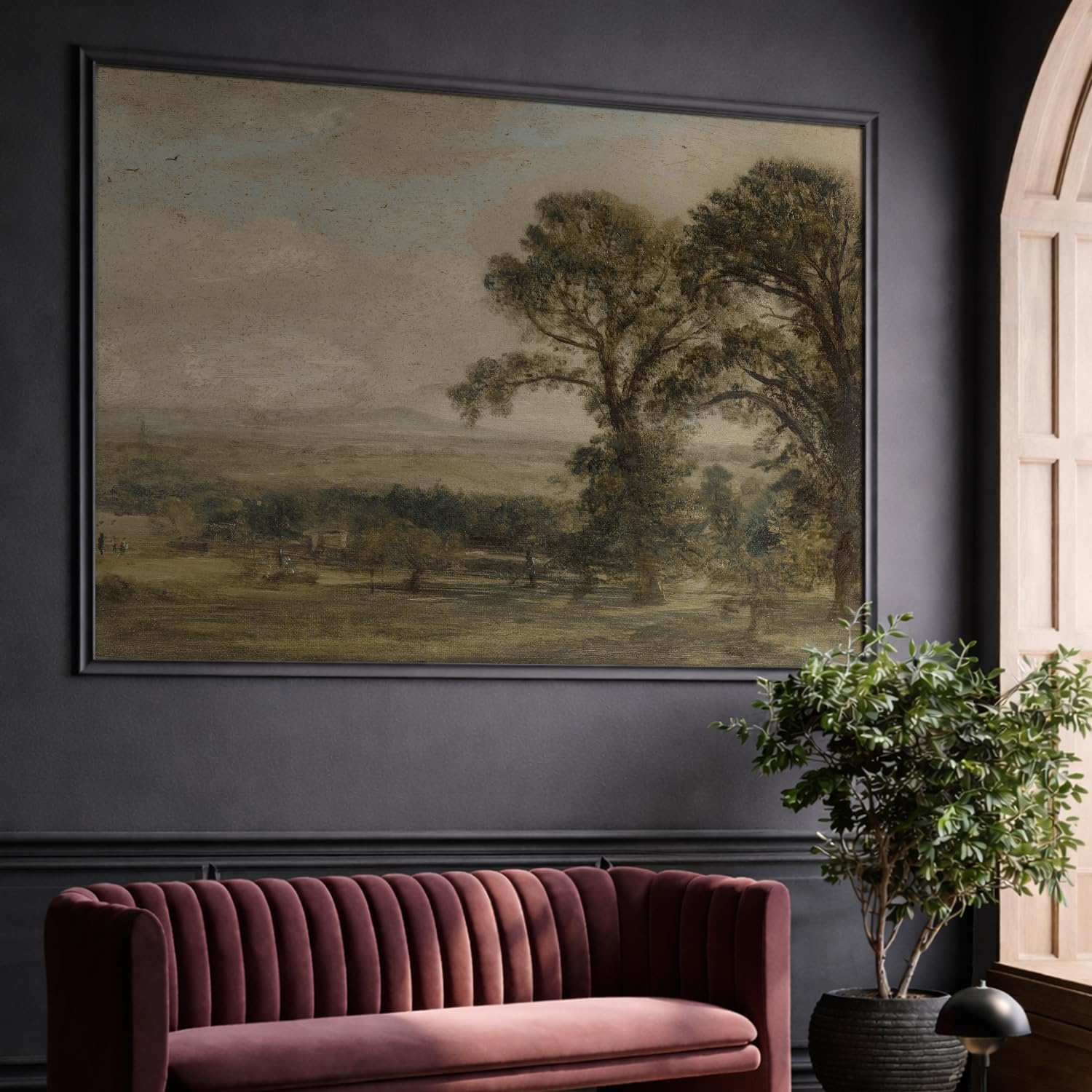
If you’ve ever walked into a dining room and done a double-take because the wall looked like someone had rolled up a Dutch Old Master and installed it — that’s the effect a vintage landscape mural wallpaper can pull off. “Mural wallpaper” means a single large-format image (usually a countryside, forest, or panoramic scene) that spans an entire wall rather than repeating in a tile pattern. “Vintage” in this context means the image has the visual texture of aged paint, weathered pigment, or hand-applied brushwork — not a crisp, high-resolution photograph. The result feels like inherited art, not a home-goods purchase. This guide is for readers who are already sold on the concept and are now standing at the decision point: which format, which quality tier, which supplier, and how not to blow the budget before the paste bucket is even open.
Why the ‘Painted’ Distinction Actually Matters Here
Here’s where the category gets slippery, and paintedwallpaper.com has a standing editorial obligation to be direct about it: a lot of product listings use the word “hand-painted” to describe what is, in practice, an inkjet-printed reproduction of a painting. That’s not fraud — a faithful inkjet print of a genuine oil painting can look extraordinary — but it is a different product with a different value proposition, and you should know which one you’re buying.
The spectrum breaks down like this:
Genuinely hand-painted panels are created by an artist applying pigment to substrate (usually non-woven or canvas-backed paper) directly. Each panel is unique. These are bespoke commissions or limited studio editions. Price range: $400–$1,200+ per panel, often sold in sets of 3–6 panels for a full wall.
Artist-originated, digitally printed means the source artwork is an original painting — watercolor, gouache, oil — that was then scanned at high resolution and printed onto wallpaper stock. The artwork is real; the reproduction is digital. This is the sweet spot of the mid-to-premium market ($150–$350 per roll or panel set). Architectural Digest’s roundup of best wallpaper brands consistently highlights this category as where serious designers shop for mural work.
Stock-image vintage prints are digitally composed scenes — often heavily filtered photography or AI-assisted illustration — dressed up in aged-texture overlays. These dominate the $50–$100 per-roll market. They can look credible in lower-light rooms, but they will not earn the “is that real art?” question.
The honest test: zoom into the product image at 200%. Genuine painted-origin work shows irregular pigment edges, wet-edge blending, and the slight imprecision of a human hand. Stock prints show clean gradients, uniform noise patterns, and repeating texture overlays if you look long enough.
The Formats: Panels, Rolls, and Why Scale Is the Decision
Vintage landscape murals come in two structural formats, and they solve different problems.
Multi-panel sets are designed as a single composition split across 3–8 vertical strips. You hang them in sequence and the full scene assembles like panels of a triptych. This is the traditional format for true murals, and it’s what most bespoke suppliers use. The advantage: the image is scaled to your wall. The risk: if you miscalculate your wall dimensions or damage one panel, replacement matching is difficult or impossible on hand-painted work.
Repeating rolls tile a landscape motif — rolling hills, a treeline, a misty valley — in a pattern that can be offset (called a “drop match,” where each strip shifts down a set distance before the pattern aligns again) or straight-matched. The Spruce’s wallpaper calculation guide notes that drop-match patterns can waste 15–30% more material per roll than straight matches, which is a cost factor that catches buyers off guard at checkout.
By the numbers:
- Average wall requiring a full mural: 12–14 linear feet wide × 9 feet tall = roughly 108–126 sq ft
- Standard non-woven roll: ~57 sq ft usable (after pattern matching waste)
- Rolls needed for a typical accent wall: 3–4 rolls minimum; budget for 4–5
- Drop-match waste penalty: add 1 extra roll per 3 ordered
If your wall is under 10 feet wide, a panel set often ends up cheaper than rolls once waste is factored in. If your wall has interruptions — doors, windows, a fireplace — rolls give you more flexibility to work around them. Elle Decor’s feature on the ongoing mural wallpaper moment explicitly recommends panel sets for dining rooms and unbroken bedroom walls, and rolls for living rooms with architectural complexity.
Picking Your Quality Tier Without Overpaying
This is where practitioners usually stall. The gap between a $90 roll and a $900 panel set feels enormous, but the actual visual difference at installation — especially in a dining room at dinner-party lighting — is narrower than you’d expect. The question is: what are you paying for at each tier, and is that the thing you actually need?
Budget tier ($50–$120 per roll or panel)
Stock-image vintage prints on standard vinyl-coated or lightweight non-woven stock. Serviceable in low-to-medium natural light. The “painted” quality holds at a viewing distance of 6+ feet. These are appropriate for a rental refresh, a kids’ room focal wall, or a space you’re staging to sell. The failure mode is close-up inspection and raking light (light hitting the wall at an angle) — both reveal the flatness of the print.

ROMAN’s
$27.48
In stock on Amazon
Check price on AmazonFor a renter-safe version at this tier, look specifically for peel-and-stick formulations on non-woven backing. Apartment Therapy’s peel-and-stick installation guide notes that non-woven backings conform to minor wall texture better than vinyl-only options, which matters for vintage-look prints where wall irregularities read as “patina” rather than installation errors.
ROMAN’s
$27.48
In stock on Amazon
Check price on AmazonMid-tier ($130–$280 per roll or panel set)
Artist-originated digital prints, usually on premium non-woven or grasscloth-texture stock. This is where the “is that real art?” question starts happening. The source artwork is a genuine painting; what you’re evaluating is print resolution (300 DPI minimum for mural-scale work), substrate texture, and color depth. Better Homes & Gardens’ 2025–2026 wallpaper trend report identifies this segment as the fastest-growing in the decorative wallpaper market, driven largely by independent artist storefronts bringing original work to print-on-demand platforms.

AMUGISH
$62.85
In stock on Amazon
Check price on AmazonThe mid-tier decision variable is substrate. A high-resolution print on flat, bright-white stock will look like a high-resolution print. The same file printed on a linen-texture non-woven or a slightly warm-toned base reads immediately as more hand-made. When you order samples — and you should order at minimum three samples before committing — hold them against your wall in both daylight and evening light before deciding.

Reyhui
$103.99
In stock on Amazon
Check price on AmazonPremium tier ($300+ per panel or panel set)
Genuine hand-painted commissions, limited-edition studio prints with hand-finishing (some studios add metallic overpainting or embossing to digitally printed base sheets), or high-end archive reprints of historic scenic wallpaper. Architectural Digest’s designer roundup names a handful of studios in this category that produce work indistinguishable from antique panoramic papers at viewing distance.
The premium-tier math only works if: (a) you’re in a permanent home, (b) the room will be photographed or heavily used for entertaining, or (c) you are genuinely buying the artwork as much as the wall treatment. If you’re flipping the house in three years, the mid-tier delivers 80% of the visual impact at 35% of the cost.
Reyhui
$103.99
In stock on Amazon
Check price on AmazonTrue Project Cost: The Number You Need Before You Click Buy
The wallpaper is the visible line item. Here’s what the full project actually costs, because getting surprised at the hardware store after you’ve already committed to $600 in panels is a bad day.
| Cost Item | Budget Range | Notes |
|---|---|---|
| Wallpaper (4 rolls / panel set) | $200–$1,400 | Varies by tier |
| Primer (wallpaper-specific) | $25–$45 | Do not skip — affects adhesion and removal |
| Paste or activator | $15–$35 | Pre-pasted panels still benefit from activator |
| Seam roller | $8–$15 | ROMAN’s — $27.48 |
| Smoother/squeegee | $10–$20 | |
| Professional install (optional) | $200–$600 | $50–$75/hr typical 2026 rate, 4–8 hrs for accent wall |
Total project range: $460–$2,115 depending on tier and install choice.
The line item most buyers skip is the primer. The Spruce’s wallpaper installation guide is unambiguous: sizing primer (a thin, paintable coat that seals the wall and makes the wallpaper easier to position and remove later) is not optional on painted drywall. Skipping it risks the paper pulling drywall facing paper on removal — a $200–$400 skim-coat repair.
AMUGISH
$62.85
In stock on Amazon
Check price on AmazonThe Decision Frame: If X, Then Y
You’ve been in the research phase long enough. Here’s the direct version:
If you’re renting or planning to move in under 4 years: peel-and-stick, budget or mid-tier, panel set sized to one unbroken wall. Prioritize non-woven backing for easier removal. Don’t spend premium-tier money on a wall you’ll leave behind.
If you’re a homeowner doing a dining room or primary bedroom feature wall: mid-tier artist-originated print, non-woven substrate, professional install for the panel alignment. This is the highest-ROI scenario in the category — the visual payoff is significant, the cost is manageable, and the room will photograph like a design magazine feature.
Reyhui
$103.99
In stock on Amazon
Check price on AmazonIf you’re furnishing a permanent home you intend to keep for 10+ years and the room matters: commission or limited-edition premium panels. Get the room professionally installed. Order 10% extra material for future repairs. This is the only tier where the “is that real art?” question gets answered with a “yes” rather than a “close.”
If you’re staging to sell: budget-tier peel-and-stick. One accent wall in a dining room or primary bedroom photographs extremely well and costs under $200 installed DIY. Real estate agents and staging professionals have documented measurable listing engagement improvements from statement-wall treatments; Hunker’s staging feature notes that accent walls consistently test well in listing photography.
ROMAN’s
$27.48
In stock on Amazon
Check price on AmazonThe sample-ordering habit is the highest-leverage thing you can do before any of these decisions. Order three samples at different tier levels. Hold them on your wall. Live with them for a week. The right choice will be obvious by day three in a way that no product page photograph can replicate.
Pricing reflects 2026 U.S. market conditions. Roll coverage and waste calculations are estimates; always verify with supplier specifications for your specific pattern and wall dimensions before ordering.